
Recently, Professor Zhu Yuanyuan's research group from our School of Chemistry and Chemical Engineering, in collaboration with Professor Lin Wenbin from the University of Chicago, has made significant progress in the application of porous polymers in the field of light-driven organic transformations. The relevant findings, titled 'Diaryl Dihydrophenazine-Based Porous Organic Polymers Enhance Synergistic Catalysis in Visible-Light-Driven Organic Transformations,' have been published as a research article in the internationally renowned journal 'Angewandte Chemie International Edition' in the field of chemical materials.
Synergetic catalysis is an important catalytic mode in the field of synthetic chemistry. Many chemical reactions involve synchronous activation of substrates, multistep transformations, and transfer of energy, electrons, and substances between different catalytic sites, requiring multiple catalysts to collaborate. However, in traditional homogeneous catalytic systems, the efficiency of synergistic coupling between different catalysts is limited due to the barrier of solvents. Therefore, the development of supported heterogeneous catalytic systems for efficient synergistic coupling is of great theoretical significance and potential practical value.
Our researchers prepared porous organic polymers based on the photo-sensitive unit 5,10-diphenyl dihydrophenazine through the free radical polymerization of functionalized ethylene monomers. They found that polymer-type catalysts exhibited significant advantages over small-molecule homogeneous catalysts in terms of light absorption range and excited-state lifetime.

Figure 1: Synthesis of Porous Organic Polymer-Based Photocatalyst Using Organic Photosensitizer
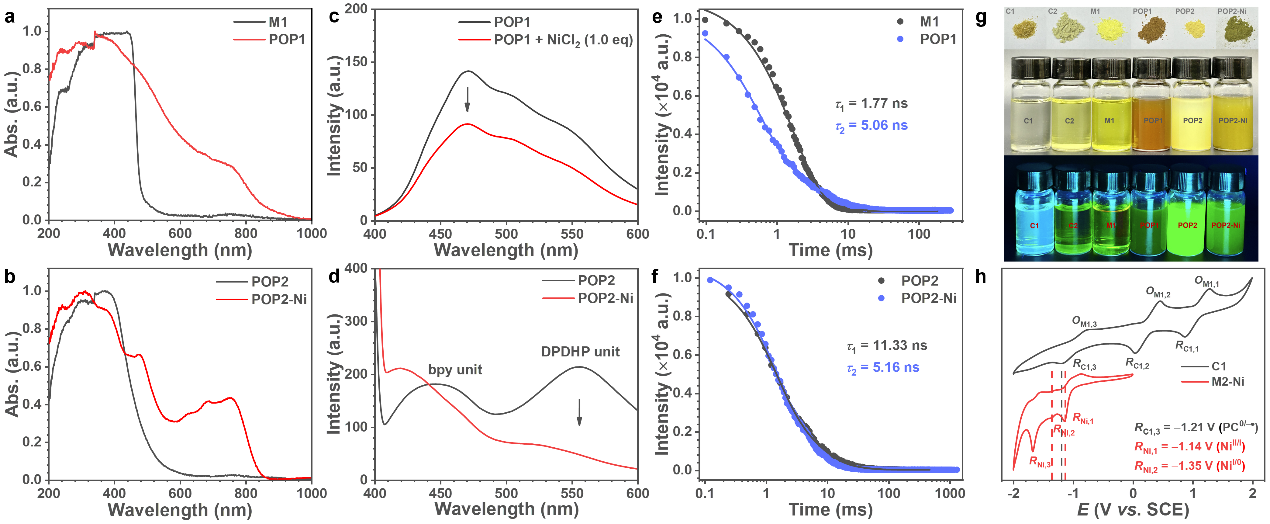
Figure 2: Optical and Redox Performance Characterization of Porous Polymer-Based Catalyst
This type of catalyst exhibits excellent catalytic capability in catalyzing visible-light-induced carbon-heteroatom cross-coupling reactions. In particular, POP1 + NiCl2 successfully catalyzed a broad-spectrum C-N bond formation reaction, with its catalytic activity being 30 times higher than that of the control homogeneous catalyst. POP2-Ni efficiently facilitated a diverse range of C-P bond formation reactions, where the solvent for such reactions was limited to methanol. In contrast, the control homogeneous catalyst could not dissolve in methanol and, therefore, failed to catalyze the reaction. The catalyst can be easily recovered after the reaction through simple centrifugation and retains high catalytic activity even after multiple cycles of reuse. This work indicates that, through the rational design of polymer structures, porous organic polymers constructed with organic photosensitive units can serve as an outstanding catalytic platform for a range of light-driven organic transformations. It provides new insights for designing heterogeneous catalysts with industrial application prospects.

Figure 3: (a) Combination of POP1 + NiCl2 catalyzing C-N bond formation reaction; (b) POP2-Ni catalyzing C-P bond formation reaction.
This research was supported by the National Natural Science Foundation of China, the Fundamental Research Funds for the Central Universities, and Hefei University of Technology. Cheng Yan, a master's student from our School of Chemistry and Chemical Engineering, is the first author of the paper, Professor Zhu Yuanyuan is the corresponding author, and Professor Lin Wenbin from the Department of Chemistry at the University of Chicago is a co-author.
Paper link: https://doi.org/10.1002/ange.202310470

 Links
Links